More Information
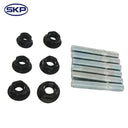
Exhaust hardware keeps every joint, flange, and connection in your system sealed and rattle-free — from the manifold bolts threading into the cylinder head down to the clamps securing flex pipes and resonators. These parts fail more often than most people expect: the extreme heat cycling of exhaust systems accelerates corrosion, and manifold studs in particular are notorious for seizing and snapping on high-mileage engines. Clamps are the most commonly replaced items here, typically when a slip joint works loose or a band clamp rusts through — inspect them any time you're under the vehicle. For manifold hardware, OEM-spec grade 8 or stainless steel fasteners are worth the small premium over generic hardware store bolts; thread pitch and shank diameter must match exactly, and some applications require spring-loaded bolt assemblies to allow for thermal expansion. Always confirm fitment by year, make, model, and engine displacement before ordering.
Signs you need replacement
- Exhaust smell or fumes entering the cabin. A failed manifold gasket or cracked flange seal caused by loose or broken studs and bolts allows raw exhaust to escape before the catalytic converter — address this immediately, as it's a CO exposure risk.
- Loud ticking or tapping at startup that fades when the engine warms up. This is a classic symptom of a broken or missing exhaust manifold stud, which allows the manifold to lift slightly when cold and reseat as metal expands.
- Rattling or droning noise from under the vehicle at specific RPMs. A loose or cracked exhaust clamp lets sections of pipe vibrate against each other or surrounding heat shields — the noise often changes pitch when you rev the engine.
- Visible rust, cracks, or deformation on an exhaust clamp or sleeve. Surface rust on a clamp body is cosmetic, but a clamp with a cracked band or stripped bolt won't hold clamping force and should be replaced before the joint separates.
- Failed exhaust inspection or a visible gap at a pipe joint. A leaking slip-joint connection that blows soot around it means the clamp has lost tension or the sleeve has deteriorated — common after 5–7 years in salt-belt climates.
Frequently asked questions
- How often do exhaust clamps and manifold fasteners need to be replaced? There's no fixed mileage interval — these are inspect-and-replace-as-needed parts. Practically speaking, manifold hardware on high-mileage engines (100,000+ miles) is prone to breakage during any manifold removal. Exhaust clamps in rust-prone regions often need replacement every 5–10 years regardless of mileage, especially on OEM slip-joint connections.
- Are stainless steel exhaust fasteners worth it over standard zinc-plated hardware? For anything near the manifold or in a high-heat zone, yes. Stainless steel (typically 304 or 316 grade) resists the corrosion and galling that makes zinc-plated bolts nearly impossible to remove later. The trade-off is cost — roughly 2–3x more per fastener — but it pays off if you ever need to pull the manifold again.
- What else should I replace when I'm replacing broken exhaust manifold studs? Replace the exhaust manifold gasket at the same time — it's cheap (typically $10–$40) and the labor overlap makes it a no-brainer. If your application uses spring-loaded bolts, replace the springs too; they lose tension over time and are often what allows leaks to develop in the first place. Budget $25–$80 for a full hardware kit.