
Select your vehicle
Wire, Cable and Related Components


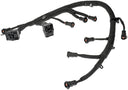


Fuel injection wiring harnesses, pump harnesses, and related fuel management wiring connect your ECU and fuel system components - injectors, pumps, pressure sensors, and fuel management modules - to reliable power and signal circuits. These harnesses fail gradually: insulation cracks from heat cycling under the hood, connector pins corrode from fuel vapor exposure, or wiring chafes against brackets until shorts develop. Most vehicles don't have a fixed replacement interval, but harnesses on high-mileage engines (100,000+ miles) or those that have seen coolant or oil leaks are prime candidates for inspection. When buying, match the harness exactly to your engine family and model year - a 5.7L Hemi injection harness won't interchange with a 5.9L Cummins diesel ICP harness. OEM-spec harnesses use the correct wire gauge, connector housings, and terminal plating; budget aftermarket units sometimes cut corners on heat-resistant sheathing, which matters when your wiring runs inches from exhaust manifolds.
Signs you need replacement
- Misfires or dead cylinders with no bad injector or coil: A damaged fuel injection harness can drop signal or power to one or more injectors intermittently - you'll see cylinder-specific misfire codes (P030X) even after swapping injectors.
- No-start or hard start with fuel pressure confirmed: If the fuel pump isn't receiving voltage through a degraded pump wiring harness, the pump won't prime - you'll have no crank-fuel pressure even with a healthy pump and relay.
- Fuel trim codes and lean/rich conditions that move with engine movement: A chafed harness that shorts intermittently under load or vibration will throw P0171/P0172 or injector circuit codes that appear and disappear unpredictably.
- Visible melting, scorching, or brittle insulation on harness sheathing: Any harness routed near a leaking exhaust manifold gasket or running hot due to a cooling system problem may show physical heat damage - replace before it causes a short or fire risk.
- Diesel ICP (injection control pressure) faults on 7.3L or 6.0L Power Stroke engines: A cracked or corroded diesel injection control pressure harness will cause ICP sensor signal loss, resulting in hard starts, low power, and P1280/P1281 codes - the harness is a known weak point on high-mileage Ford diesels.
Frequently asked questions
- Is there a recommended replacement interval for fuel injection harnesses? There's no mileage-based interval, but proactive inspection makes sense at 100,000–120,000 miles, especially on turbocharged or diesel engines where under-hood heat is severe. If you're already replacing injectors or a fuel pump, inspecting and replacing the harness at the same time prevents a comeback repair shortly after.
- Are OEM harnesses worth the premium over aftermarket on fuel system wiring? For most applications, a quality aftermarket harness from a reputable supplier is adequate and significantly cheaper. The area to be cautious is connector housings and terminal material - OEM connectors use exact-fit terminals and weather sealing. On diesel ICP harnesses and fuel management harnesses, where signal integrity matters more, OEM or OEM-equivalent is worth the extra cost.
- How difficult is it to replace a fuel injection harness, and what else should I replace at the same time? Difficulty ranges from moderate to high depending on the engine - V8 and V10 multi-port injection engines often require intake manifold removal to access the full harness run. Budget 2–5 hours of labor. While the harness is out, replace any corroded injector O-rings or connectors. Fuel pump harness swaps on in-tank setups run $150–$350 in parts plus 1–2 hours labor.