
Select your vehicle
CV Boots and Related Components
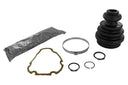


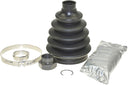


CV boot kits protect the constant velocity joints in your front axles - and on many AWD/4WD vehicles, the rear axles too - by keeping grease in and road contamination out. A CV boot is a pleated rubber or thermoplastic sleeve clamped to the outer housing and axle shaft; when it cracks or tears, the joint loses lubrication and ingests dirt, accelerating wear rapidly. Boots typically last 80,000–100,000 miles under normal conditions but fail earlier from road debris, improper installation, or age-related cracking. Replacing the boot kit alone (boot, grease, and clamps) is only viable if the joint itself is still smooth and uncontaminated - if grease has been flung or the joint feels rough, you'll need a full axle shaft instead. When buying, confirm inner vs. outer boot position, check the clamp style (ear-type vs. band), and verify shaft diameter and boot length against your application. OEM-spec kits from brands like Beck/Arnley or OE Solutions offer reliable fitment; budget kits vary in rubber durometer and grease quality.
Signs you need replacement
- Grease splattered on the inside of the wheel well or on the axle shaft. This is the most direct indicator - a torn boot has been flinging CV grease at speed, and the joint is already running dry.
- Clicking or popping noise during low-speed turns. A rhythmic click on acceleration through a turn points to a worn or contaminated outer CV joint, often caused by a failed boot that went unnoticed.
- Visible cracks, splits, or collapsed pleats on the boot itself. Even without active grease loss, a boot that's cracked or folded inward will fail shortly and should be replaced before joint damage occurs.
- Vibration through the floorboard or seat at highway speeds. A compromised inner CV joint - typically from a torn inner boot - can cause driveline vibration that worsens under acceleration load.
- Torn boot discovered during brake, suspension, or tire work. Routine inspections often catch boot damage before symptoms develop; replacing it immediately is far cheaper than waiting for joint failure.
Frequently asked questions
- Can I replace just the CV boot, or do I need to replace the entire axle shaft? If the boot tore recently and grease is still present with no roughness or clicking in the joint, a boot kit is the right repair. If the joint has been running dry, feels notchy when rotated by hand, or is already noisy, replace the complete axle shaft - repacking a worn joint is a short-term fix at best.
- Are aftermarket CV boot kits as reliable as OEM, and does boot material matter? Quality aftermarket kits from brands like Dorman, Beck/Arnley, or Moog use materials that meet or exceed OEM spec. Thermoplastic (TPE) boots are more crack-resistant in cold climates than standard rubber; rubber boots are generally fine in moderate climates. Avoid kits with thin-wall boots or insufficient grease quantity - the included grease pack should be specific to CV joints, not a generic filler.
- How difficult is a CV boot replacement as a DIY job, and what else should I replace at the same time? Difficulty ranges from moderate to high depending on the vehicle. Split-boot kits can be installed without removing the axle shaft, cutting labor significantly, but conventional kits require axle removal. Plan to replace both inner and outer boots on the same shaft if one is worn - labor is already done. Inspect axle snap rings and clamps for reuse; replace them if deformed.